Portugal may look small on a map, but that can be deceptive.
From the vineyards of the Douro Valley and the historic cities of Lisbon and Porto to the wild Alentejo, the beaches of the Algarve and the volcanic landscapes of the Azores, there is an extraordinary amount to experience. One of the biggest mistakes we see travellers make is trying to fit too much into one trip.
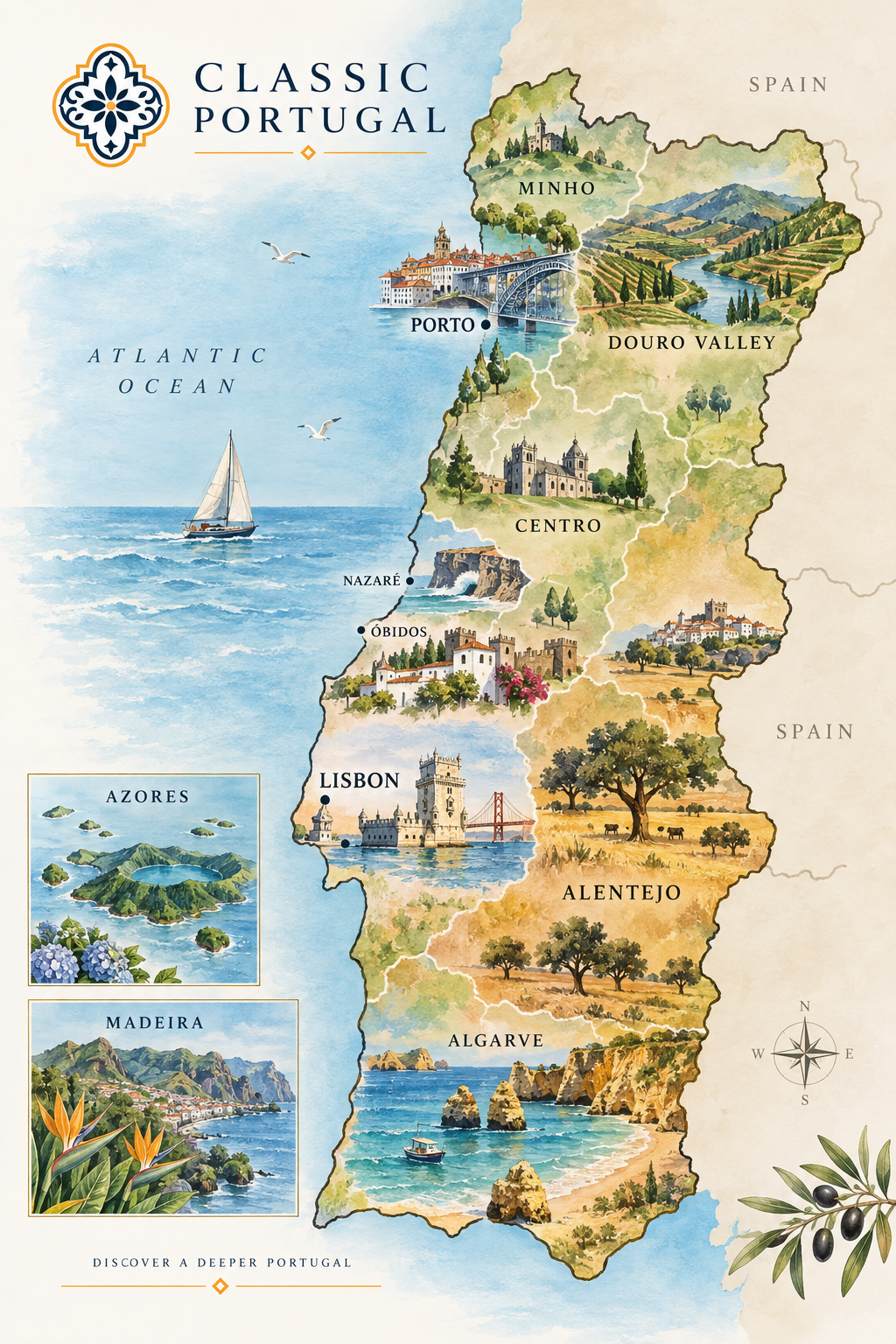
The best way to see Portugal is not to race from one end of the country to the other collecting destinations. It is to choose your regions carefully, allow enough time in each place and build a journey that gives you time to actually experience Portugal. So, how long do you need, where should you go, and what is the best way to travel around Portugal?
How Long Do You Need to See Portugal?
For a first journey to Portugal, 10 to 14 days is ideal. You can certainly experience Portugal in a week, but you will need to be selective. Seven nights works particularly well for two regions — perhaps Lisbon and the Algarve, or Porto and the Douro Valley — rather than attempting to cover the entire country.
With around 10 nights, you can comfortably combine three distinct areas. Lisbon, the Alentejo and Porto might work beautifully, for example, or Lisbon, Porto and the Douro Valley. Two weeks gives you considerably more freedom. You can travel from north to south at a relaxed pace, incorporate smaller towns and countryside, or spend several nights somewhere simply enjoying your hotel, the coast or the landscape.
Portugal rewards slow travel. A night spent in the Alentejo or Douro Valley can often be just as memorable as a day visiting several famous monuments.
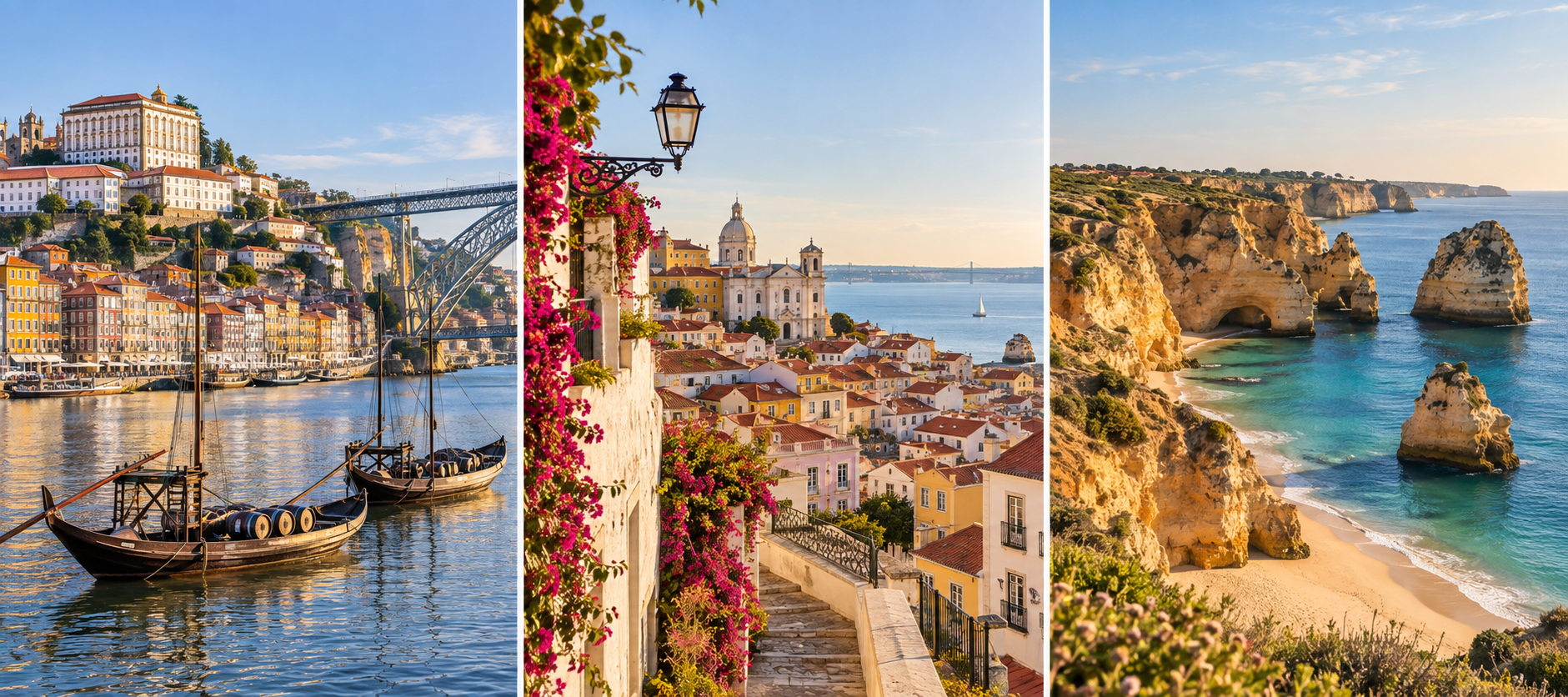
1. Should You Travel Independently, Take a Tour, or Use a Private Driver?
There is no single right answer. It depends on how independently you like to travel and how much of the organisation you want to manage yourself.
Portugal is relatively easy to explore independently, particularly if you are simply travelling between Lisbon and Porto. Both cities are walkable in their historic centres and are connected by rail. However, many of Portugal's most memorable places lie beyond the main railway routes.
Wine estates, rural villages, archaeological sites, remote beaches and parts of the Alentejo and Douro Valley are considerably easier to experience with private transportation. For a more comfortable journey, we generally favour a combination of private drivers and knowledgeable local guides rather than putting travellers onto a traditional escorted tour.
It gives you the freedom of independent travel without having to worry about driving, parking, navigation or logistics. It also means your journey can change character from day to day. One day might involve exploring Lisbon privately with a historian; another could be spent travelling through the Alentejo with your driver, stopping at a winery and a tiny hilltop village along the way. You still have plenty of time to wander independently, choose your own restaurant or simply do nothing at all.

2. What Is the Best Way to Travel Between Lisbon, Porto and the Algarve?
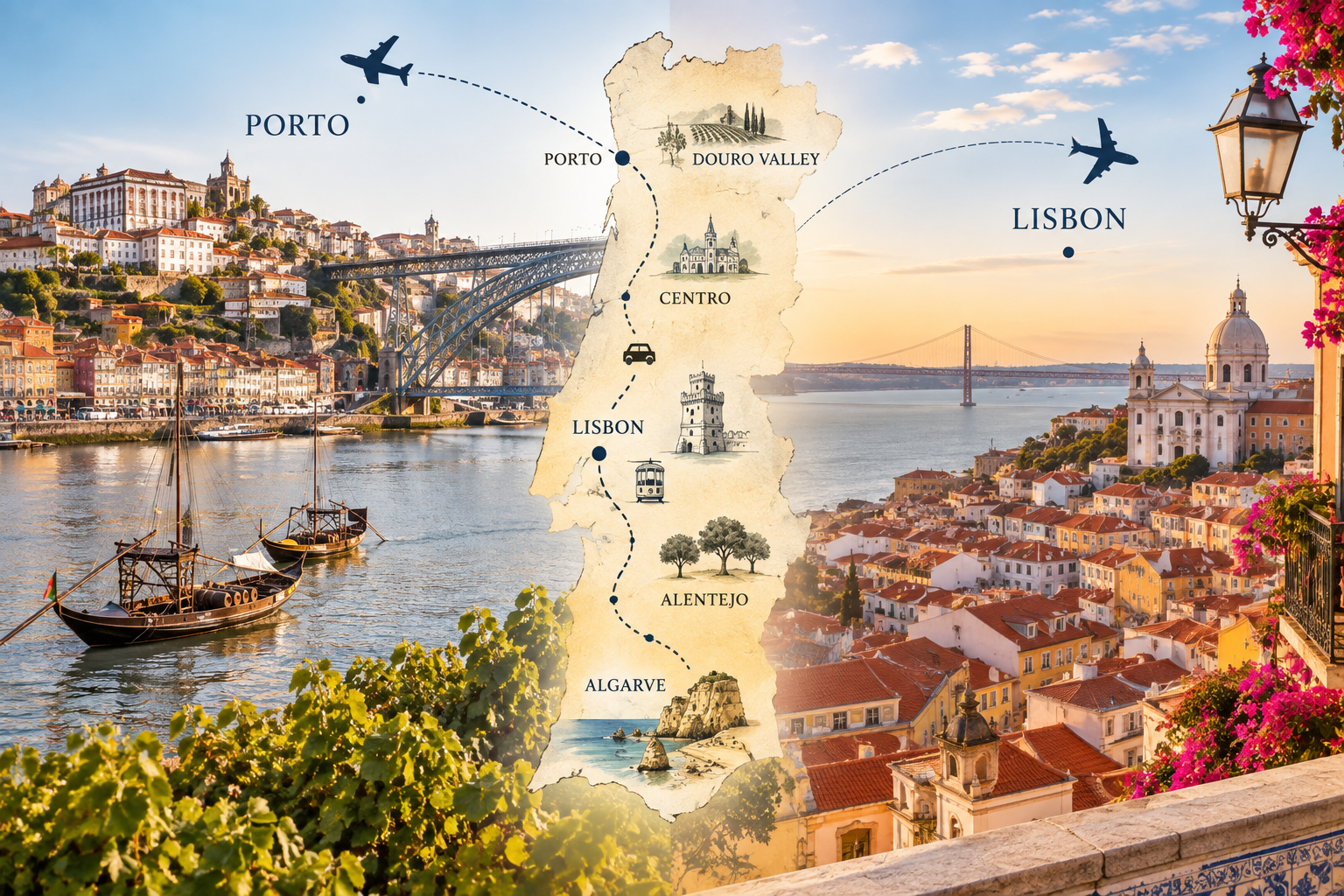
For Lisbon and Porto, the train can be an excellent option. The journey takes around three hours and avoids the need for a car in either city. Alternatively, travelling privately by road allows the transfer itself to become part of the journey. Rather than simply travelling from Lisbon to Porto, for example, you might stop in Óbidos, Nazaré, Coimbra, Aveiro or another part of central Portugal along the way. The same principle applies when travelling south.
Between Lisbon and the Algarve, a private transfer allows you to travel through the Alentejo or along Portugal's beautiful southwest coast rather than simply treating the day as transportation. For some itineraries, flying between regions can also make sense, particularly when incorporating Portugal's islands. The best solution is often a mixture of transport rather than using the same method throughout the entire trip.

3. How Many Regions Should You Visit in One Trip?
Usually fewer than you think. We would rather design a journey through three regions experienced properly than five regions visited in a rush. Changing hotels every night or two quickly becomes tiring. Packing, checking out, travelling, waiting for rooms and unpacking again all take time away from actually experiencing the destination.
As a general guide:
7 nights: one or two regions
10 nights: two or three regions
14 nights: three or four regions
There are exceptions, of course, particularly when neighbouring regions work naturally together. Lisbon and the Alentejo combine beautifully. Porto and the Douro Valley are another natural pairing. Lisbon, Cascais and Sintra can all form part of the same section of a journey without requiring constant hotel changes. The important question is not simply how many places can we fit in? It is how much of Portugal can we experience without the journey beginning to feel like work?

4. Is It Better to Start in Lisbon or Porto?
Either can work extremely well. If international flight options allow, we often recommend an open-jaw itinerary — flying into Lisbon and home from Porto, or vice versa. This avoids unnecessarily returning to your starting point and creates a much more natural journey through the country.
Starting in Porto can be particularly lovely if you want to begin with northern Portugal and the Douro Valley before gradually travelling south. Starting in Lisbon works beautifully if you want to begin with the capital before exploring the Alentejo, central Portugal or the Algarve. Rather than automatically building a circular itinerary, look at where you ultimately want to travel and allow the route to flow naturally.
5. Should You Include the Douro Valley?
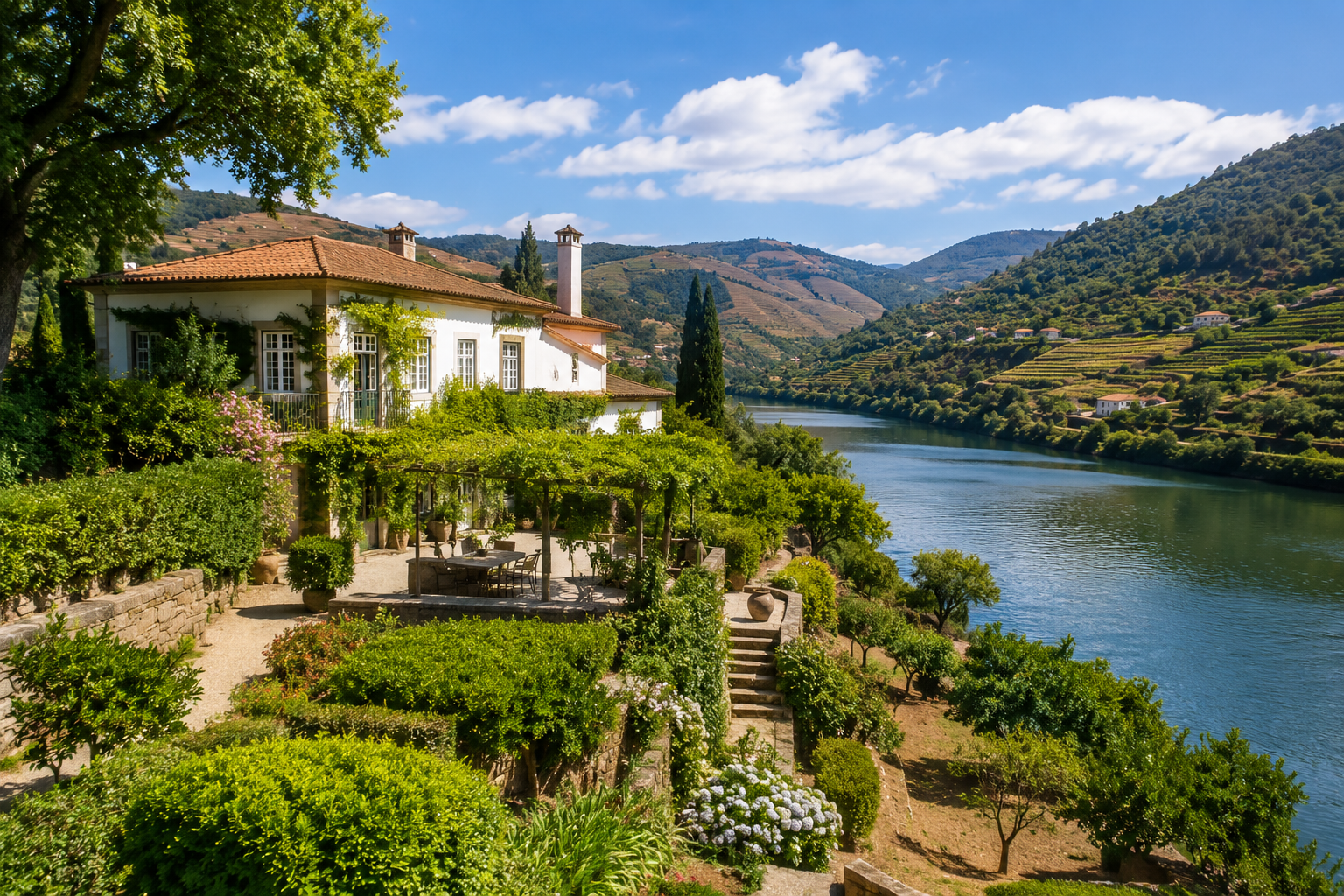
If you love wine, landscapes and beautiful hotels, yes — and ideally stay overnight. The Douro Valley is possible as a day trip from Porto, but staying for two or three nights gives you an entirely different experience.
The landscape changes throughout the day as the light moves across the terraced vineyards, and the valley becomes wonderfully peaceful once many day visitors have returned to Porto. You might visit a historic quinta, enjoy a long vineyard lunch, take a private boat along the Douro, or simply spend an afternoon beside the pool overlooking the vines. You do not need to be a serious wine enthusiast to enjoy the Douro. It is one of Portugal's great landscapes and deserves time in its own right.
6. Can You Combine Mainland Portugal With Madeira or the Azores?
Absolutely — provided you have enough time. Madeira and the Azores are not simply extensions of mainland Portugal. They are distinct destinations with their own landscapes, climate, food and character.
For the Azores, we generally recommend allowing at least four nights on São Miguel rather than trying to squeeze the island (or islands!) into three or less days. Madeira also deserves several days, particularly if you want to combine Funchal with hiking, mountain scenery, gardens and the island's dramatic coastline.
With a 10 day - 14 day journey, combining one island destination with one or two mainland regions can work beautifully.Trying to combine Lisbon, Porto, the Algarve, Madeira and the Azores in one short holiday, however, usually means spending far too much of your trip travelling between them.
The islands deserve to be experienced, not ticked off a list.

7. When Is the Best Time to Visit Portugal?
Portugal can be visited throughout the year, but spring and autumn are particularly lovely. April, May, June, September and October often offer an excellent balance of pleasant weather and opportunities to explore comfortably.
July and August are naturally busier and hotter, particularly in Lisbon, the Algarve and inland regions such as the Alentejo. They can still be wonderful months to travel, especially if the journey includes the coast, resorts and plenty of time to relax.
Winter can be an excellent choice for travellers more interested in food, wine, culture and cities than beach weather. Lisbon and Porto remain lively throughout the year, while hotels and historic sites can feel noticeably quieter outside the main season.
The Douro and Alentejo also change dramatically with the seasons, which means there isn't necessarily one universally 'best' time to visit. It depends on the Portugal you want to experience.

9. Why Does a Private, Tailor-Made Journey Work So Well in Portugal?
Portugal lends itself particularly well to private travel because some of its best experiences aren't necessarily found in its biggest cities. The best experiences can be scattered between them.
A family-run winery hidden down a country road. A fishing village on the Atlantic coast. A tiny restaurant you would never have found yourself. A historic estate in the Alentejo. A viewpoint high above the Douro. A local guide who can explain why a seemingly ordinary building has been standing there for five centuries.
Private travel allows those experiences to become part of the journey rather than inconvenient detours from it.It also gives you something we consider increasingly important: time. Not every morning needs an 8:00 AM departure. Not every afternoon needs an activity. And not every evening needs a reservation. A carefully designed private journey should have structure where structure adds value and freedom where it doesn't.
At Classic Portugal Travel, we design each journey individually around the people taking it. We consider how you like to travel, the pace you enjoy, your interests, your preferred style of hotel and the experiences that will genuinely add something to your time in Portugal. Because ultimately, the best way to see Portugal isn't about seeing as much as possible.
It is about experiencing the right places, at the right pace, in a way that feels entirely your own.